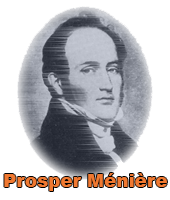
Meniere's Disease

Symptoms of Meniere's Disease

Meniere's disease is a life disrupting illness that usually presents with hearing loss, pressure in the ear, tinnitus (or ringing in the ear), severe imbalance, or vertigo. Meniere's disease is a disease of the inner ear. It is felt to be caused by too much fluid build-up in the inner ear. Although there are many theories about the cause of Meniere's disease, nothing is definitively known and there is still much research being done to try to pinpoint the origin. Below are the typical symptoms of Meniere's disease. A patient may present with all of these symptoms, but, in many cases, a patient will only have one or two of the symptoms.
  • Vertigo is the most distressing symptom of Meniere's disease. Vertigo is a sensation of rotation or spinning. The vertigo can last from 10 minutes to many hours. It may also be associated with nausea and vomiting. After the vertigo has gone away, most patients have imbalance for one to two days until returning to normal.

  • Hearing loss is also an associated symptom of Meniere's disease. However, absence of this symptom does not mean a patient does not have Meniere's disease. Hearing loss in Meniere's disease usually fluctuates. In most cases where there is hearing loss, it is in only one ear, but, in rare instances, a person can have a hearing loss in both ears. Typically, the hearing loss is in the low tones. If left untreated, hearing can drop until there is a permanent loss in that ear.

  • Pressure or fullness in the diseased ear is a common complaint with patients with Meniere's disease. This can occur before or during an attack. It will usually resolve when the attack has resolved.

  • Tinnitus, or a ringing or buzzing in the ear, can also occur with Meniere's disease. This is usually a result of the hearing loss. It can be described as a seashell sound or a low-tone buzzing.
The above classic symptoms of Meniere's desease are not always present, but that does not exclude the diagnosis.

Diagnosis of Meniere's Disease

An initial evaluation is performed by the physician. A patient's medical history and present medications are reviewed. An in-depth discussion about presenting symptoms and previous treatment will be a part of the initial evaluation. An ear exam will be performed with the microscope to rule out any obvious causes. After this initial visit, the following tests will be performed to try and confirm the diagnosis.
  1. Audiogram or hearing test-the hearing loss in Meniere's disease is a low frequency, upsloping, sensorineural (nerve) hearing loss. This exam is important to determine which ear is causing the symptoms.

  2. Electronystagmogram or balance test (ENG)-this test also assists in identifying which ear is the problem. However, if this test is normal, it does not rule out Meniere's disease.

  3. Magnetic Resonance Imaging (MRI) of the brain-this is performed to rule out any tumors on the balance nerve, which may be causing the patient's symptoms.

  4. Laboratory tests-these are performed to see if there are any other causes of the patient's symptoms. Certain infections can cause Meniere's-like symptoms. For example, syphilis and Lyme's disease can cause Meniere's-like symptoms years after the exposure. Individuals who have certain autoimmune disorders can also experience Meniere's-like symptoms. These include lupus, rheumatoid arthritis, and thyroid disorders.
Treatment of Meniere's Disease

Once a diagnosis is made, a course of action must be taken. Treatment options vary-from conservative changes to the diet to more radical destruction of the balance system. Treatment decisions will be based on how well the attacks are controlled and what the hearing level is. Typically, the first line of therapy is conservative medical management.

  • Medical Management (1st line of therapy)

    1. Low Salt Diet-this is followed in an attempt to decrease the fluid load on the inner ear. A diet with less than 2000 milligrams sodium a day is recommended. Most processed foods have large amounts of sodium, so it is good to read labels. A small number of patients can control their disease with a low-salt diet alone, but most patients require a diuretic in conjunction with the diet.

    2. Diuretic-this is a drug that is taken on a daily basis to help the ear get rid of excess fluid. Typically the drug of choice is a mixture of hydrochlorothiazide and triamterene. Some patients my need a potassium supplement with the diuretic.

    3. MeniettTM (Medtronic Xomed, Inc.)-this is a small machine that provides low-pressure pulses through a ventilation tube that is placed in the eardrum during a clinic visit. The device is used for approximately 5 minutes, three times a day. This can be done at home or at work.

    4. Dexamethasone perfusion-This is performed by placing a ventilation tube in the eardrum while in the clinic. A steroid mixture is then administered through the ventilation tube while the patient lies flat for 30 minutes. Sometimes the perfusion is repeated on a periodic basis. This is still considered experimental therapy but is being used at many institutions.

    5. Gentamicin perfusion-This is performed when the hearing loss is so great that the patient no longer receives any benefit from the affected ear but continues to experience vertigo. Gentamicin, an antibiotic that is toxic to the inner ear, is administered through a ventilation tube that is placed in the eardrum in the clinic. This destroys the balance mechanism by chemically destroying it. It can also make the hearing worse. Unfortunately, the patient may have a permanent imbalance from this procedure.

  • Surgical Management

    1. Endolymphatic sac decompression-this is done by making an incision behind the ear, exposing the mastoid bone, the bony protrusion behind the ear. The endolymphatic sac is identified, and the bone covering the endolymphatic sac is removed. This decompresses or relieves pressure over the sac, giving the surgery its name. In addition, a shunt, or tiny tube, may also be positioned into the sac. The theory is that the shunt will be able to drain off the excess endolymph. This is an outpatient surgery that takes approximately on and one and a half hours. This treatment is controversial because it is not successful in every patient and sometimes needs to be revised for shunt failure.

    2. Vestibular nerve section-this is a surgery that is performed with a neurosurgeon because it is an intercranial procedure and requires several days of hospitalization. In this surgery, the vestibular nerve is cut. The patient will have extreme vertigo immediately after surgery, followed by some weeks of imbalance. The period of imbalance varies from patient to patient. Imbalance can be a permanent problem.

    3. Labrynthectomy-this surgery is performed only when a patient now longer has useful hearing in the affected ear but still experiences vertigo. An incision is made behind the ear, and the canals responsible for balance are identified and drilled away. The vestibular or balance nerve is also cut. This surgery also requires hospitalization. The patient will have one to two days of vertigo, followed by some weeks of imbalance. The period of imbalance can vary from person to person and may be permanent. The patient will be deaf in the ear undergoing the surgery.


Copyright © 2000 - . University of Arkansas for Medical Sciences. All Rights Reserved.
This site created and maintained by Intuitive Creations